
Official Belgian data, explained
Pupils and students… to tertiary education by province in Belgium (2024)
This page maps Pupils and students enrolled by education level, sex and NUTS 2 region — Education level: Pre-primary to tertiary education for one nationally comparable 2024 slice. Every figure below uses the same disclosed definition, unit, geography and source.
Education
What this indicator measures
Pupils and students enrolled by education level, sex and NUTS 2 region. Complete annual Eurostat source dimensions, units and observation flags are retained in one compact cube.
Indicator dossier
Data passport
- Selected reference period
- 2024
- Geography
- provinces
- Boundary set
- Statistical sectors 2024
- Measure
- Pupils and students enrolled by education level, sex and NUTS 2 region
- Unit
- count
- Comparable areas
- 11
- Coverage
- 100%
Indicator dossier
Selected slice
Exact catalogue filters applied to the map, statistics and comparison.
- Education level
- Pre-primary to tertiary education
- Sex
- Total
Latest published slice
How to read the pattern
- Median
- 261,538count
- Unweighted area mean
- 270,988.36count
- Minimum
- 70,288count
- Maximum
- 482,868count
Across the valid national comparison set, the median is 261,538 count. Values extend from 70,288 to 482,868 count. This describes geographic variation; it is not a score of local quality.
Geography
Map of Belgium
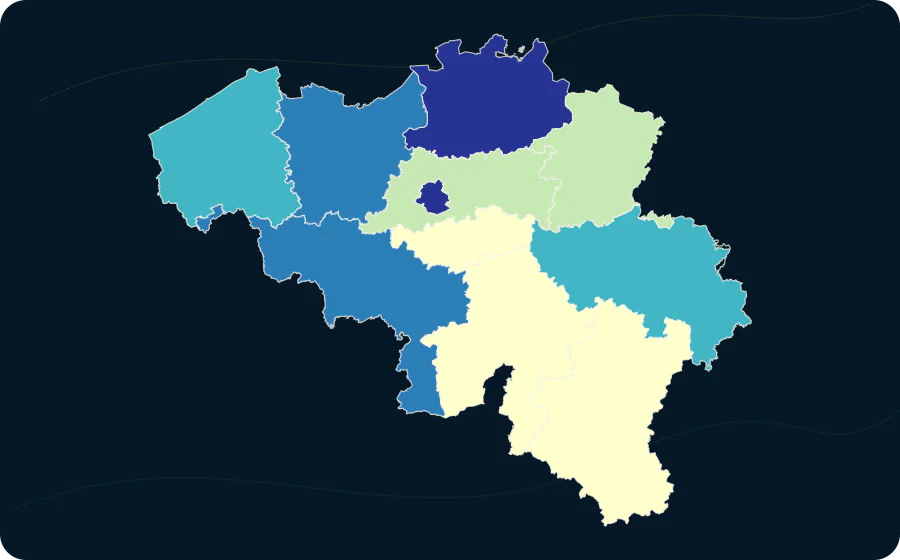
- 70,288–128,0423 areas
- 128,042–261,1632 areas
- 261,163–279,5282 areas
- 279,528–410,0302 areas
- 410,030–493,2912 areas
Areas
Value distribution
| Value | Areas |
|---|---|
| 70,288–207,814.67 | 4 |
| 207,814.67–345,341.33 | 4 |
| 345,341.33–482,868 | 3 |
Explore this exact slice in the atlas Download this data as CSV
provinces
Highest and lowest values
From 11 comparable areas, the table shows a concise descriptive high-and-low sample. Equal values do not imply equal local circumstances.
| Highest | 1 | Région de Bruxelles-Capitale | 04000 | 482,868 count |
|---|---|---|---|---|
| Highest | 2 | Provincie Antwerpen | 10000 | 466,834 count |
| Highest | 3 | Provincie Oost-Vlaanderen | 40000 | 406,532 count |
| Highest | 4 | Province du Hainaut | 50000 | 326,749 count |
| Highest | 5 | Province de Liège | 60000 | 273,401 count |
| Highest | 6 | Provincie West-Vlaanderen | 30000 | 261,538 count |
| Highest | 7 | Provincie Vlaams-Brabant | 20001 | 252,128 count |
| Highest | 8 | Provincie Limburg | 70000 | 200,772 count |
| Highest | 9 | Province de Namur | 90000 | 126,939 count |
| Highest | 10 | Province du Brabant wallon | 20002 | 112,823 count |
| Lowest | 11 | Province du Luxembourg | 80000 | 70,288 count |
Method and limitations
Method and limitations
No missing value is imputed. Where colour classes are used, their breaks and colours come from the catalogue; source-declared suppression remains missing.
The area mean gives every published geographic area equal weight. It is not weighted by population, exposure or area size.
Native NUTS2 value mapped only to exact province-equivalent geography; not a municipality value. Selectors define the source universe and unit.
Default-filter coverage on the exact eleven-code Belgian NUTS-2/province-equivalent domain.
Read the methodologySources, licence and provenance
Sources, licence and provenance
- Source
- Eurostat
- Licence
- Eurostat reuse policy
- Licence
- CC BY 4.0